
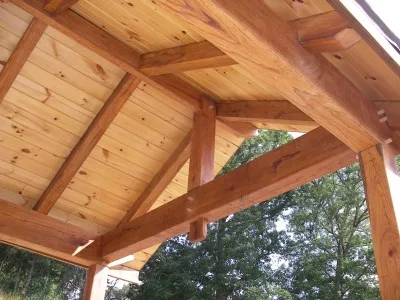
Timber frame hybrid construction can be aesthetically pleasing due to the craftsmanship of using indigenous local hardwoods. The overall project combines timber with state-of-the-art insulating practices to yield very high efficiency, maintaining comfort in the home.
A few ideas for achieving a higher R-value for the structural envelope include larger width wall plates. I prefer to see deep wall thickness for windows and doors to have the width for sills and door jambs. Alternating 2×4's for the wall plates with 2×8 wall plates can lead to much higher overall R-values for the home.
This enables you to minimize conductive heating and cooling from the outside elements of your structure. The article on frost-proof footings also helps with this minimization.
Encasement of the Structural Envelope
Encasement of the structural envelope has everything to do with how well your home remains comfortable year-round. Have you ever wondered how a 1/8th inch Styrofoam cup prevents heat transfer when drinking hot liquids? Imagine if you had a 1/2″ of this all around your home.
There is a product called P-2000 that can be used for all of the exterior walls and really makes the home very tight. A 1/2″ sheet of P-2000 has a space-aged Mylar coating to reflect with taped seams. When used with Iconene foam insulation, it is one of the most efficient methods you can use.
It is also best to use P-2000 in all of the ceilings to keep the temperature and humidity in a controlled environment. A little more dollars up front save huge profits after just a few years. It is well worth looking into, with the expenses of heating and cooling.
Key Techniques
- Indigenous local hardwood timber framing
- 2×8 wall plates for superior R-values
- P-2000 with Mylar coating on exterior walls and ceilings
- Iconene foam insulation for maximum air sealing
- Alternating stud patterns to break thermal bridging
- Deep window and door sills for improved performance
Combining all of these techniques — timber frame aesthetics, deep wall construction, P-2000 encasement, and ICF foundations — results in a home that is not only beautiful but extraordinarily comfortable and energy-efficient throughout the mountain seasons.
Related Article
Frost Proof Footings